
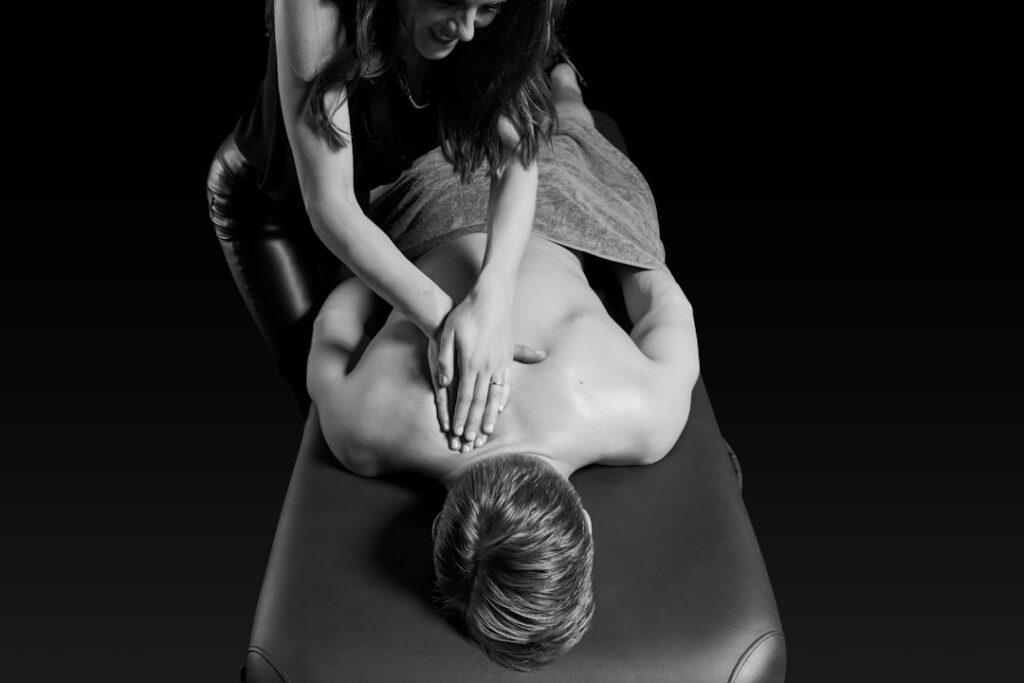
Spinal adjustments are controlled movements applied to joints of the spine to reduce pain, improve movement, and influence how the nervous system processes mechanical information. The effects are usually modest and condition-specific, so an adjustment should be understood as one possible treatment tool rather than a cure for every health problem.
What is a spinal adjustment?
A spinal adjustment, also called spinal manipulation, uses a hand or instrument to apply a brief, controlled force to a spinal joint. The movement may be quick and shallow, or it may involve slower mobilization within the joint’s normal range.
An adjustment is not intended to “put a bone back into place” in the literal sense. Spinal bones are connected by joints, discs, ligaments, and muscles. Most everyday back and neck problems do not involve a vertebra being dramatically displaced. Instead, symptoms may involve irritated tissues, reduced joint movement, muscle guarding, sensitivity in the nervous system, or several of these factors at the same time.
The goal is generally to change movement and pain sensitivity enough to make normal activity easier.
Why can an adjustment affect pain?
The strongest scientific explanation involves the interaction between joints, muscles, nerves, and the brain. Spinal joints contain sensory receptors that detect pressure, stretch, movement, and position. A controlled adjustment stimulates these receptors and sends signals through the nervous system.
Those signals may temporarily alter how the spinal cord and brain interpret pain. This is sometimes described as a “gating” effect: non-painful movement signals can compete with or reduce the prominence of pain signals. Adjustments may also influence muscle activity and reduce protective muscle tightening in the treated region.
Pain is not determined only by tissue damage. Sleep, stress, previous injury, fear of movement, physical conditioning, and the nervous system’s level of sensitivity can all affect symptoms. A mechanical stimulus such as an adjustment may therefore produce relief even when it does not create a major structural change visible on an X-ray or scan.
What causes the popping sound?
The familiar popping sound is usually associated with cavitation, a rapid change in pressure and gas within the fluid-filled space of a synovial joint. It is similar to the sound that can occur when some joints are moved quickly or when knuckles are cracked.
The sound is not proof that a bone moved back into alignment, and silence does not mean that an adjustment failed. Research also suggests that the audible pop is not required for symptom improvement. Several joints may produce sounds during one movement, and the sound may come from a nearby joint rather than the exact area that feels painful.
The meaningful part of treatment is the overall response in pain, movement, and function—not the presence or number of sounds.
Does an adjustment physically move the spine?
Yes, but usually only by a small amount and for a short period. Studies of spinal manipulation show that forces can create measurable motion in spinal joints and surrounding tissues. However, the idea that a practitioner can precisely move one vertebra into a permanently corrected position is an oversimplification.
The body is constantly adapting to standing, walking, sitting, lifting, and turning. Muscles and the nervous system may respond to an adjustment by changing tension, coordination, or protective guarding. Improvements may therefore reflect a combination of joint motion, sensory input, muscle response, confidence with movement, and natural recovery.
This is one reason modern explanations focus less on permanent realignment and more on temporary changes in mobility and pain processing.
What conditions may respond?
Evidence is most supportive for certain musculoskeletal problems, especially low-back pain and some forms of neck pain. Benefits tend to be small to moderate and are often similar to those reported with other non-drug treatments.
For low-back pain, spinal manipulation may modestly improve pain and daily function in both short-term and longer-lasting cases. It may help with activities such as walking, standing, sleeping, or completing household tasks. Exercise, education, gradual activity, and other conservative treatments may be used alongside it.
Some people with neck-related headaches or tension-type headaches may also report improvement, although results vary and the research is less consistent. An adjustment should not be presented as a treatment for unrelated diseases such as high blood pressure, infections, digestive disorders, or cancer. High-quality evidence does not show a clear general health benefit for those conditions.
Why might results differ from person to person?
Several factors influence the outcome:
- The cause and duration of the pain
- Whether the problem involves a joint, muscle, disc, nerve, or multiple tissues
- Sleep quality and daily stress
- Physical activity and work demands
- Previous injuries or surgery
- Expectations about treatment
- Whether movement and exercise are gradually restored
A resident dealing with winter stiffness, prolonged driving, home maintenance, or repetitive lifting may experience a different pattern of symptoms than someone whose discomfort developed after a fall or sports injury. Seasonal cold may make muscles feel tighter, but it does not by itself explain every episode of back or neck pain.
Short-term relief is useful, but lasting improvement usually depends on returning safely to normal movement and addressing contributing habits. Repeated adjustments without attention to strength, mobility, work setup, or activity tolerance may not solve the underlying problem.
Are spinal adjustments safe?
For most appropriately screened adults, temporary soreness, stiffness, fatigue, or a mild headache can occur after manipulation. These effects commonly resolve within a day. Serious complications are rare, but they can occur.

Neck manipulation deserves particular caution because rare cases of cervical artery dissection and stroke have been reported. Research has not established in every case whether manipulation caused the artery problem, because similar artery injuries can occur after ordinary sudden neck movements, sports, whiplash, severe coughing, or vomiting. Even so, the potential risk should be discussed before forceful neck treatment.
A careful health history matters. Conditions that may require avoiding or modifying manipulation include recent major trauma, suspected fracture, severe osteoporosis, active cancer affecting bone, infection, significant spinal instability, progressive neurologic problems, and certain inflammatory or vascular disorders. Blood-thinning medication and recent surgery may also affect treatment decisions.
When should back or neck pain be evaluated urgently?
Immediate medical evaluation is appropriate for symptoms such as:
- New loss of bladder or bowel control
- Numbness around the inner thighs or groin
- Severe or progressive weakness in an arm or leg
- Trouble walking or major loss of coordination
- Fever, unexplained weight loss, or a history of cancer
- Severe pain after a fall, crash, or other trauma
- Sudden severe headache, dizziness, double vision, slurred speech, or difficulty swallowing after neck pain or treatment
These signs may indicate a problem that requires medical testing or urgent care rather than routine manual treatment.
What should residents ask before treatment?
Useful questions are practical and specific:
- What condition is being treated?
- What improvement is reasonably expected?
- Are there non-manipulative options, such as exercise or mobilization?
- What symptoms would make treatment unsafe?
- How will progress be measured?
- What should happen if symptoms worsen or fail to improve?
A scientifically grounded approach treats the adjustment as one component of care, uses the lowest reasonable force, reassesses the response, and avoids claims that spinal manipulation can correct every health problem. The clearest measure of benefit is whether pain, movement, sleep, and everyday function improve over time.
